
 Posted by
A Pune-based logistics company came to us last year with a problem that sounded simple on the surface: their website felt slow and clunky. The real story was underneath it. Four WordPress plugins were fighting each other over checkout logic, every update broke something else, and their operations team was manually re-entering shipment data that should have synced on its own. They didn’t need a prettier homepage. They needed to know whether to keep patching what they had, or rebuild it around how their business actually worked.
That’s the exact fork in the road most growing businesses hit sooner or later, and it rarely has an obvious answer from the outside. A content management system and a custom web application aren’t competing versions of the same thing, they solve fundamentally different problems, and choosing the wrong one doesn’t just cost you a redesign down the line. It costs months of your team working around software that was never built to do what you’re asking it to do. This guide walks through exactly how to tell which one your business needs in 2026, what each option realistically costs in India, where each one breaks down as you scale, and the trade-offs most agencies won’t bring up until you’re already locked in.
What’s the Real Difference Between a CMS and a Custom Web App?
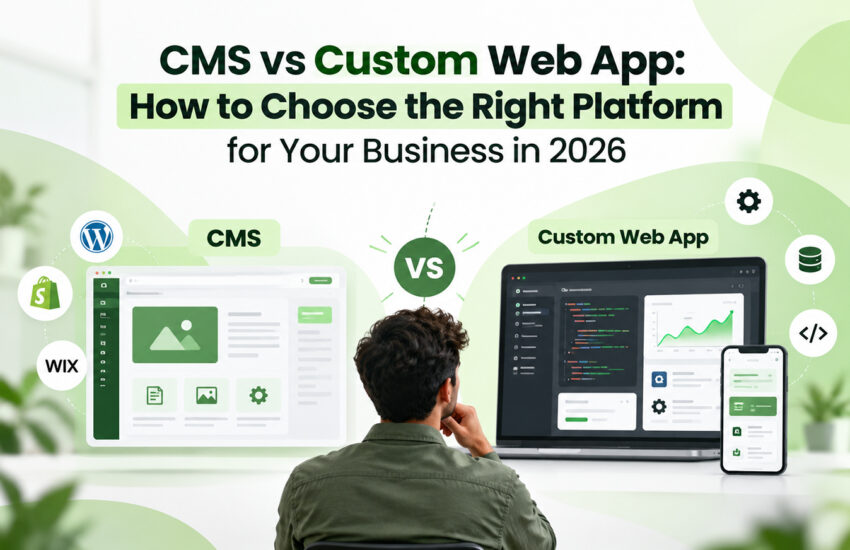
A content management system is pre-built software, like WordPress, Shopify, or Drupal, that lets you publish and manage content through a dashboard without writing code. A custom web app is software built from scratch around your specific workflows, data structures, and business logic.
The distinction matters because a CMS gives you speed and a library of ready-made plugins, while a custom build gives you control over exactly how data moves through your system. One isn’t universally better. A restaurant chain publishing menus and locations has very different needs from a logistics company tracking live shipment status across forty vendors.
CMS vs Custom Web Application: Which One Fits Your Business Right Now?
If your website’s main job is publishing and updating content, a CMS almost always wins on cost and speed. If your website’s main job is running a process, think bookings, approvals, inventory, custom pricing logic, a CMS starts fighting you within the first year.
When a CMS Is the Right Call
Go with a CMS vs custom website development approach when your site is primarily content-driven: a corporate brochure site, a blog, a services page, or a small catalogue store. If you’re still weighing a CMS vs custom web app decision and content publishing is your main concern, this is exactly the kind of build our CMS platform covers.
The trade-off nobody mentions in the sales pitch: every plugin you add is a dependency you don’t control. We’ve seen clients running twelve or more plugins just to replicate basic business logic that a custom build would have handled natively, and each one is a potential conflict point during the next WordPress core update.
When a Custom Web Application Makes More Sense
A custom web application development approach earns its higher upfront cost when your business runs on workflows a CMS wasn’t designed for, multi-step approvals, real-time inventory sync, role-based dashboards, or integrations with internal ERPs. We build these as true custom software, not CMS plugins stretched past their intended use.
Here’s a quick way to check which category you’re in. You’re probably past what a CMS can comfortably handle if:
- You’re paying developers monthly just to keep plugins compatible with each other
- Your team manually re-enters the same data in two or more systems
- A core business process (pricing, scheduling, approvals) lives in spreadsheets because the website can’t handle it
If two or more of those are true, a CMS website vs custom coded website comparison usually tips toward custom, even accounting for the higher build cost.
How Much Does Each Option Cost in India?
A CMS-based business website in India typically runs lower on upfront build cost because you’re configuring existing software rather than writing it. A custom web app costs more to build but carries lower long-term licensing and patch-management overhead.
These figures are illustrative, not quotes, since scope changes everything. A standard CMS website with a handful of pages and a few integrations is the cheaper starting point. A custom enterprise web application development project, with role-based access, API integrations, and custom reporting, costs more because every feature is coded rather than configured.
One judgment call we make early with clients: if your five-year roadmap includes a second product line, a partner portal, or an app companion, building custom from the start is often cheaper than migrating off a CMS later once years of content and custom-coded workarounds are tangled into it.
How Long Does Each Platform Take to Launch?
A CMS site with standard features typically launches in weeks because most of the underlying functionality already exists and just needs configuration and content. A custom web app takes longer, usually a few months for a meaningful first version, because the logic, database structure, and interface are all built from zero.
This is the trade-off MMF Infotech is upfront about with every client choosing between speed and fit. If you need something live before a product launch or a funding deadline, a CMS gets you there faster, even if it means revisiting the platform decision in eighteen months. If the launch date has some flexibility, building custom the first time usually costs less in total than building a CMS site now and rebuilding custom later.
Which Platform Scales Better as Your Business Grows?
A custom web app generally scales more predictably because its architecture is built around your actual data volume and traffic patterns from day one. A CMS can scale too, but usually needs additional caching layers, a CDN, and sometimes a move to headless architecture once traffic or content complexity grows past what the default setup handles comfortably.
We worked with an e-commerce client whose WordPress and WooCommerce setup started slowing down once their SKU count crossed a few thousand products with seasonal pricing rules. Rather than a full rebuild, we restructured parts of their database layer and caching logic, which bought them real headroom without starting over. That’s often the more realistic middle path than “rebuild everything custom.”
What Should You Actually Do Next?
Before committing either way, map out three things: which parts of your site are pure content versus active business logic, what your traffic and data volume will look like in two years, and what your in-house team can realistically maintain without constant outside help.
If the content side dominates, start with a CMS and keep the architecture clean enough to extend later. If workflow and data logic dominate, building custom from the outset through a custom web app development company will save you a migration down the line.
That conversation is diagnostic, not a sales pitch. You walk away knowing whether your site needs configuration or construction, and roughly what each path costs before you commit a rupee.
Either way, the worst outcome is guessing. Businesses that pick blind usually end up paying twice, once for the wrong platform, and again to undo it two years later.
You can start that conversation here and get a straight answer before you spend on either path.
Frequently Asked Questions
Q1. Is a CMS or a custom web app better for a small business website?
A1. For most small businesses with primarily informational sites, a CMS like WordPress is the more practical choice. It launches faster and costs less upfront. Custom builds make sense only when the small business runs a specific operational process, like bookings or inventory, that off-the-shelf plugins can’t handle cleanly.
Q2. How much does custom web app development cost compared to a CMS in India?
A2. Custom development typically costs more upfront because every feature is coded from scratch, while a CMS configures existing functionality. The gap narrows over time since CMS platforms carry recurring plugin and maintenance costs that custom apps mostly avoid once built.
Q3. Can I switch from a CMS to a custom web app later without losing data?
A3. Yes, with proper planning. Content, user data, and product catalogues can usually be migrated, though the process takes longer and costs more the longer you wait, since custom integrations built around the CMS also need rebuilding.
Q4. Is WordPress considered a CMS or a custom web app?
A4. WordPress is a CMS. It can be heavily customised with plugins and custom themes, but its core architecture remains CMS-based, meaning it’s optimised for content publishing rather than bespoke business logic.
Q5. Which option is more secure, CMS or custom web application?
A5. Security depends more on implementation than platform type. CMS platforms are popular attack targets because of their scale, but stay secure with regular updates. Custom apps have a smaller attack surface by default but require the development team to build security in deliberately rather than relying on platform defaults.
Q6. How do I know if my business has outgrown its CMS?
A6. Common signs include needing a growing number of plugins just to replicate basic business logic, manual double data entry between systems, and core processes like pricing or approvals living in spreadsheets because the website can’t handle them.