
 Posted by
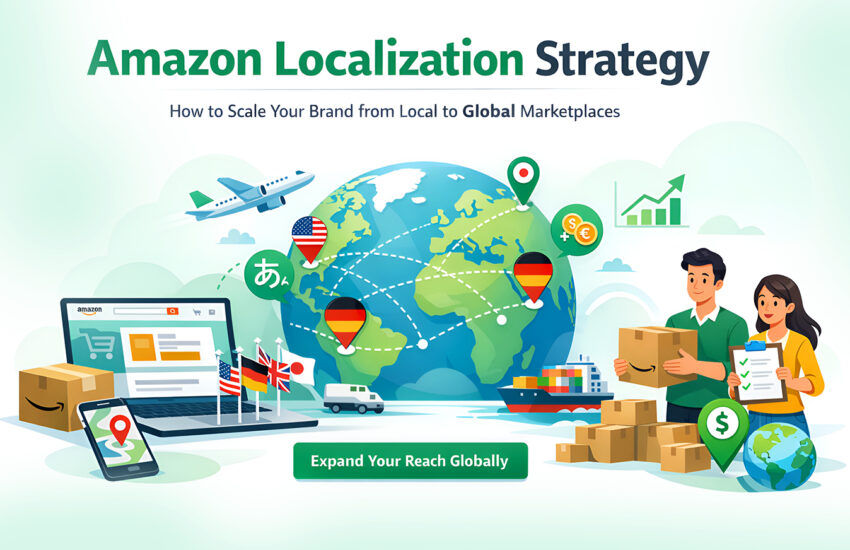
 Expanding your business beyond your home country is one of the fastest ways to increase your revenue by two to three times. Available at over 20 global marketplaces, Amazon offers sellers access to millions of customers worldwide, which has made entering new markets easier for e-commerce sellers across the globe. But for Amazon’s cross-border selling, having a good product alone is not enough; to make it reach the target market, business owners have to adopt effective localization strategies for every region to enhance their product visibility, which is what will get sellers optimal sales, eventually.
In this blog, we will understand how to sell on Amazon internationally and how to scale from a local seller to a successful global brand using a structured and practical approach.
What Is Amazon Global Expansion?
Amazon global expansion means selling your products in international marketplaces such as the USA, UK, Europe, UAE, or Australia. Through programs like Fulfillment by Amazon (FBA) and Global Selling, Amazon has made it easier for brands to list their products in multiple countries from one central account, without the need to invest in heavy retail in opening physical stores in every country.
Even though this is a good way to boost your sales and profit, to do that, sellers need to understand that every marketplace is different, which makes having effective localization strategies crucial, as:
- Customer behaviour and needs vary
- Keyword ranking and trends change
- Different competitive pricing and expectations
- Different legal and tax requirements
Localization vs Translation – Why It Matters
The common misconception that sellers have when they start to sell on Amazon internationally is that translating their product listing word-for-word will work. That is the difference between translation and localization. Translation converts language, whereas localization means adapting your product to the region-specific culture, trends, customer behaviout and buying mindset of the market.
Some examples are:
- US customers may search “trash bags” while UK customers search for “bin liners”.
- In Germany, buyers often prioritize technical specifications.
- In Japan, clean visuals and detailed instructions increase trust.
Amazon Global Selling Strategy
For successful Amazon international selling, there is a set of steps that sellers need to follow to enhance visibility. Many business owners choose to hire an Amazon account management agency, which ensures that they enter international markets after proper research. The common localization strategies include:
Choosing the Right Marketplace
Not every product is for every market. Before expanding, research which country makes sense for your product. Conduct a comprehensive market analysis to identify demand and core players in the market before launching your product.
Make sure your research answers questions like:
- Is there demand for my product in that region?
- How competitive is the category?
- What are the average selling prices?
- What are import duties and taxes?
Conduct Country-Specific Keyword Research
Keyword ranking is different in every country. Just because a product is ranking well in one country does not guarantee that it will rank the same in another. Each marketplace has different search terms, spelling variations, and trending phrases that help products rank.
Use native-language keyword research to find:
- High-volume main keywords
- Long-tail buying keywords
- Seasonal terms that get sales.
Adapt Your Pricing Strategy
Pricing directly impacts the profitability of a product, its market positioning, and its competitiveness in the marketplace. The goal is not to be the cheapest product; it is to provide value for money while also protecting your profit margins.
Things to account for:
- Pricing of the competitor
- Local currency rounding
- Cost of shipping
- Fulfillment and storage fees
Understand Legal Compliance Requirements
Amazon marketplace expansion comes with legal responsibilities. Not researching and understanding the legalities before launching your product can lead to listing suspension. Planning compliance helps you save time and protects your account.
Depending on the region, you may need:
- VAT registration
- Product safety certifications
- Import documentation
- Trademark protection
Adapt Your Amazon PPC Strategy
Advertising your product is important for brand visibility. And every advertising campaign performs differently across regions because of different CPC rates, competition level, and conversion rates. Amazon advertising services allow you to rank faster.
For a successful PPC strategy, start with:
- Automatic campaigns to gather data
- Manual keyword campaigns
- Brand defense campaigns
Protect Your Brand Globally
Global expansion increases customer base and also brand exposure to fraud and dupes, which makes protecting your products even more important. Registering your trademark in key markets and the brand registry are the key ways to ensure safety.
This gives the seller:
- Access to A+ content
- Sponsored brand ads
- Protection from hijackers
- Brand analytics data
Final Thoughts: Go From Local Success to Global Success
To successfully expand your local business in global markets, you need more strategies than just listing your products correctly. The opportunity is massive, but success depends on preparation and execution. If you want to scale internationally, start the process by researching the market in depth and putting together a strong localization strategy. With the right strategy, you can ensure profitable growth.MMF Infotech has successfully launched many local brands globally and is ready to help you with yours.