
 Posted by
 Every Prime Day, thousands of Amazon sellers make the same mistake.
They cut prices. A supplement brand in Austin dropped its flagship product from $34.99 to $24.99 during Prime Day 2024. Their unit sales increased 40%. Their profit per unit dropped 68%. By the end of the event, they had moved more inventory than in any previous month and generated less total profit than a typical Tuesday in March.
Across their category, eleven competitors did the same thing. All twelve brands spent two days racing each other to the bottom and handed Amazon a record revenue day while quietly destroying their own Q3 margins.
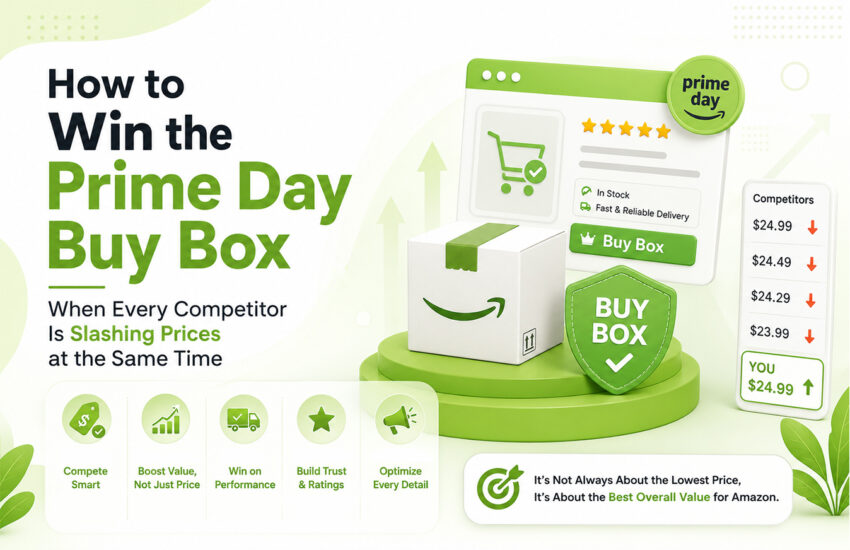
Every year, certain sellers win the Buy Box during Prime Day without offering the lowest price. Understanding their Amazon Buy Box strategy is what separates brands that use Prime Day as a growth event from brands that use it as an expensive lesson in competitive dynamics.
Why the Buy Box Matters More During Prime Day Than Any Other Time
Prime Day traffic multiplies the stakes of every percentage point of Buy Box ownership.
On a typical Tuesday, losing 20% of Buy Box share costs a meaningful but recoverable amount of revenue. During Prime Day, when category traffic can spike 300% to 500%, that same 20% Buy Box loss represents a materially different number. Prime Day Amazon sales are won or lost in the Buy Box, and the Buy Box is won or lost before the event starts.
Amazon determines Buy Box eligibility across multiple dimensions simultaneously, not price alone. Brands that understand this compete on the full scorecard. Brands that only understand the price variable spend Prime Day discounting margin that they cannot recover
Price Matters, but Amazon Is Scoring Six Things Simultaneously
Competitive pricing is one input into Amazon’s Buy Box algorithm. It is not the only one, and during Prime Day, it is frequently not the decisive one.
Amazon pricing optimisation for Prime Day means establishing a minimum price floor before the event, a threshold below which the discount produces negative margin contribution even after volume gains, and holding it. Brands that define this floor in advance resist the psychological pressure of watching a competitor drop 15% and reflexively matching them.
What Amazon is simultaneously evaluating: fulfilment method and speed, inventory availability, order defect rate, customer service response time, seller feedback score, and listing conversion rate. A brand with a 0.4% order defect rate and 98.7% positive feedback wins the Buy Box over a lower-priced competitor with a 2.1% defect rate because Amazon’s customer experience model weights reliability heavily when order volume spikes.
Inventory Availability Is a Buy Box Signal, Not Just a Logistics Issue
Stockouts during Prime Day do not just lose sales. They damage Buy Box eligibility scores that persist weeks after the event ends.
Amazon factors inventory reliability into seller performance metrics. A brand that stocks out at hour fourteen of a forty-eight-hour Prime Day event signals to Amazon’s algorithm that it cannot be relied upon during high-demand periods, a signal that affects Amazon seller account management scores into August and September.
Demand forecasting for Prime Day should begin eight weeks out. Historical Prime Day velocity data, category trend analysis, and conservative assumptions about traffic multipliers should inform an inventory position that ensures availability through the final hour of the event, regardless of how aggressively competitors discount.
Advertising Amplifies Buy Box Performance It Does Not Replace It
Amazon PPC management services during Prime Day are not about outbidding competitors for every keyword. They are about staying visible for the searches where your conversion data already shows strong performance.
Brands entering Prime Day with well-structured Sponsored Products campaigns targeting their highest-converting exact match terms, brand defence campaigns protecting their own search territory, and competitor targeting campaigns intercepting buyers mid-comparison have a structural advertising advantage that higher-spending but poorly-structured competitors cannot easily overcome with budget alone.
The advertising and Buy Box relationship is reinforcing. Higher conversion rates from well-targeted traffic improve Buy Box signals. Stronger Buy Box ownership improves organic placement. Better organic placement reduces the cost-per-click required to compete in paid placements. Brands that enter Prime Day with this flywheel operating spend less per sale than those trying to buy visibility through raw bid increases.
Account Health Determines Whether Strategy Can Execute
Amazon conversion rate optimisation and campaign investment produce no return if account health issues are suppressing Buy Box eligibility in the background.
Order defect rate, late shipment rate, pre-fulfilment cancellation rate, and customer message response time are all metrics Amazon evaluates continuously. A seller with a late shipment rate above 4% entering Prime Day is already operating with a Buy Box disadvantage that no pricing strategy or advertising budget can fully compensate for.
Account health review should happen thirty days before Prime Day. Any metric outside Amazon’s performance targets needs to be addressed before the event, not during it, when volume spikes make every operational problem worse and remediation timelines compress dangerously.
Listing Quality Is the Conversion Foundation; Everything Else Depends On
Amazon listing optimisation services deliver their highest return when applied before a high-traffic event rather than during one.
A listing with a 9% conversion rate entering Prime Day generates 2.25x the sales from identical traffic as a listing converting at 4%. That difference compounds across the traffic multiplier of the event. The gap between a well-optimised and an average listing during Prime Day represents significantly more revenue impact than any reasonable bid adjustment or pricing change.
Primary image communicating product value at thumbnail scale. Title incorporating high-intent search terms buyers actually use during event shopping. Bullet points answering the three objections that most commonly prevent purchase in your specific category. A+ content that builds the confidence a new buyer needs to commit during a high-purchase-velocity event. Review count sufficient to signal social proof to first-time buyers encountering the brand under Prime Day traffic conditions. This is what Amazon marketplace competition is actually won on, not the discount percentage announced in the deal badge.
The Prime Day Playbook for 2026
The Prime Day Playbook for 2026 relies on strict, proactive execution over last-minute reactions. Success begins eight weeks out by locking in firm price floors and building a robust inventory position to sustain availability through the event’s final hour. Thirty days prior, run a comprehensive account health audit to clear any performance flags before the traffic surge hits.
Later on, adjust each product page along with how ads are grouped – this helps capture more visitors. Focus paid searches on words people actually buy from popular ones that look good only on paper; get descriptions ready ahead of time so extra clicks turn into actual sales. While things run, check who holds the main purchase spot every hour, stepping in fast when slipping happens using behind-the-scenes tweaks, not slashing prices and hurting profit.
After the event ends, take time to review what happened. Look at how much money each product actually made, not just total sales numbers. Because real gain comes from keeping costs low while selling smart. Profit matters more when it lasts beyond one busy week. Winning means holding onto earnings, not chasing quick growth that burns through cash.
Final Thoughts
The supplement brand that dropped its price to $24.99 during Prime Day 2024 has a different Prime Day plan for 2026. They held their price floor during a test event in Q4 2024, focused on listing optimisation and account health in the months preceding it, and generated 28% higher profit on 15% lower unit volume than their 2024 Prime Day performance.
At MMF Infotech, we help Amazon brands build the operational foundation for Amazon seller account management, listing optimisation, advertising structure, and pricing strategy that makes Prime Day a profitable growth event rather than an expensive margin destruction exercise. When every competitor cuts prices, the brands that win are the ones Amazon trusts most with its customers.