
 Posted by
 Amazon has always given an upper hand to sellers who move faster, price genuinely, and create content better than the competition. In 2026, the sellers are doing all three together, and they all have one thing in common: they built AI for Amazon FBA into the core of how they operate, not as an experiment, but as infrastructure
This is not about replacing the judgment that experienced sellers have developed over years. It is about giving judgment better data, faster answers, and fewer hours lost to tasks that technology handles more accurately than any person working manually ever could.
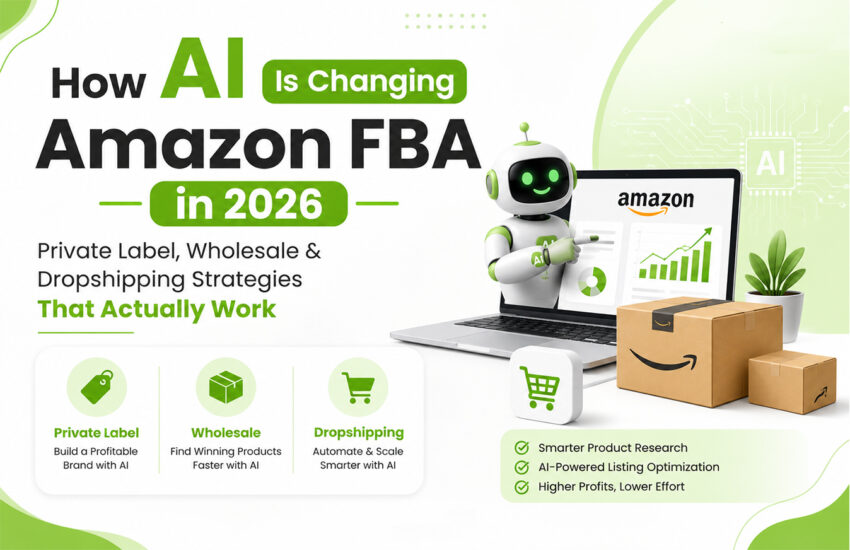
Private Label Evolution: Finding the Hidden Gaps in Saturated Markets
Private label used to be straightforward. Find an underserved niche, source a product, optimise the listing, and grow. The playbook worked because most sellers were operating on instinct and basic keyword tools.
The time is no longer in existence when launching a product without having a deep market analysis and validation is an expensive gamble rather than a calculated risk. AI-powered private label strategies change this by giving sellers access to demand signals, competitive gap analysis, and trend forecasting that previously required either specialist consultants or months of manual research.
Most new AI tools scan countless product pages at once, spotting when feedback turns sour – a hint people want something better. Before demand spikes, these systems catch rising interest patterns others miss by hand. When running your own brand, knowing early means avoiding crowded spaces, instead stepping into openings rivals overlook.
Wholesale 2.0: Compressing Weeks of Sourcing Into Hours
Squeezing profit from bulk sales on Amazon means chasing thin margins. Success often belongs to sellers able to lock in stronger deals from dependable sources. Reliable delivery matters just as much as low cost. Tracking down these vendors used to eat up huge chunks of time for wholesalers.
AI wholesale sourcing for Amazon is compressing what used to take weeks into hours. AI-powered sourcing tools can analyse supplier catalogues, cross-reference product performance data on Amazon, assess competitive density, and surface the products most likely to generate sustainable margin, all before a single conversation with a supplier begins.
Nowhere near just picking suppliers, machines learn patterns in how vendors perform over time. When competition shifts prices overnight, smart systems adjust without human input. Demand guesses stop shops from piling up goods nobody buys. Red marks pop up if a provider slips on delivery promises – way before orders go missing. These moves aren’t flashy tricks – they’re baseline habits now for wholesalers aiming to scale.
Precision Dropshipping: Overcoming the Reputation Problem at Scale
Most people think dropshipping on Amazon feels sketchy- the reason being that too many sellers care about speed, not service. Truth is, the system works fine when done right. Mistakes came from choices, not structure.
AI dropshipping strategies are changing the execution layer significantly. The most immediate impact is on product selection. Out there, algorithms keep an eye on shifting markets – spotting which items move fast without oversaturated sellers waiting in the wings. Before any agreement gets signed with a wholesaler, patterns emerge. Guessing? Not so much anymore. What shaky start do most face when diving into dropshipping? It fades when data leads instead of hunches.
What matters just as much? The way AI manages daily operations. Routing orders might flow automatically. Talking to suppliers could happen without human input. Price changes may adjust themselves. Stock checks might run on their own. All of this cuts down on hands-on work. Less effort means dropshipping can grow more easily. Fast replies stay possible. Meeting Amazon’s speed standards becomes manageable.
Product Research Has Permanently Changed
Regardless of business model, Amazon product research with AI represents one of the most significant shifts in how sellers approach opportunity identification.
Back then, flipping through category pages, squinting at BSR numbers, guessing interest by counting reviews – this patchwork method left holes in understanding. Just when someone pieced together that a product was rising, the chance to act usually slipped away.
What happens when machines scan live searches, past buying habits, price shifts, and yearly trends all at once? These systems spot openings human analysts skip – not due to poor judgment, yet simply because minds cannot match the pace of algorithmic processing. Sellers using such tech wisely now find market analysis speeding them ahead instead of slowing them down.
Inventory Management: The Hidden Profit Lever
Stockouts cost sales. Overstock costs margin. For FBA sellers, getting inventory levels wrong in either direction has direct financial consequences, and Amazon’s storage fee structure means the cost of overstock compounds over time.
AI inventory management for Amazon sellers addresses this by replacing reactive stock decisions with predictive ones. Starting with how fast items sell, AI looks beyond just what’s left on shelves. Instead of relying only on inventory counts, it weighs past buying trends across different times of year. Because suppliers take varying amounts of time to deliver, those delays shape when orders should go out. By guessing future needs more accurately, restocking stays ahead without piling up excess. High product availability sticks around, yet space and holding fees stay low.
For sellers managing large catalogues, this capability alone can meaningfully improve profitability without changing a single other aspect of the business.
The Compounding Effect: Building a Moat Against Manual Competitors
The sellers who will look back on 2026 as the year their business changed are not necessarily the ones with the most products or the biggest advertising budgets. They are the ones who recognised that Amazon seller AI tools had matured to the point where ignoring them was a competitive disadvantage rather than a cautious choice.
Amazon FBA business growth with AI is not a single decision. It is a series of workflow improvements: better research, smarter sourcing, tighter inventory control, faster repricing that compound over time into an operation that is genuinely difficult for manually-run competitors to keep pace with.
The technology is accessible. The question is whether your Amazon business is built to take advantage of it.
Final Thoughts
Right now, artificial intelligence isn’t just coming – it’s already shaping how Amazon sellers stay relevant. If your work involves branded products, bulk stock handling, or shipping directly from suppliers, smarter tools are stepping in – cutting decision time, spotting useful patterns, then refining daily workflows down to small details. Those using such systems at present tend to adjust more smoothly when markets shift or rivals multiply over time.
One reason AI stands out? It sharpens each step of selling on Amazon FBA. Instead of guessing, tools powered by artificial intelligence handle product searches, connect with suppliers, predict stock needs, adjust prices, and then review outcomes – all with less hands-on work. Over time, those who thrive online may rely less on hunches, more on systems that learn, adapt, speed things up. The edge comes not from working harder but from thinking more clearly, guided by what the numbers actually say.
At MMF Infotech, we help Amazon sellers leverage advanced AI-driven strategies to grow and scale their businesses across private label, wholesale, and dropshipping models. Our services include Amazon account management, product research, listing optimisation, inventory management, PPC advertising, marketplace automation, and performance-driven growth solutions. By combining marketplace expertise with modern AI-powered workflows, we help sellers improve profitability, streamline operations, and build sustainable success in the highly competitive Amazon marketplace.